- calendar_today August 14, 2025
.
Electric vehicles were thought to be on the fast track to market dominance in the US. But their rise has hit a wall, with US sales falling and their proliferation threatened by a lack of charging infrastructure. In the past year, electric car sales growth has turned negative for the first time after more than 12 straight months of growth, YoY. Consumers have already turned away from the EVs offered by Genesis and Volvo. The two automakers have now both responded by trimming their offerings.
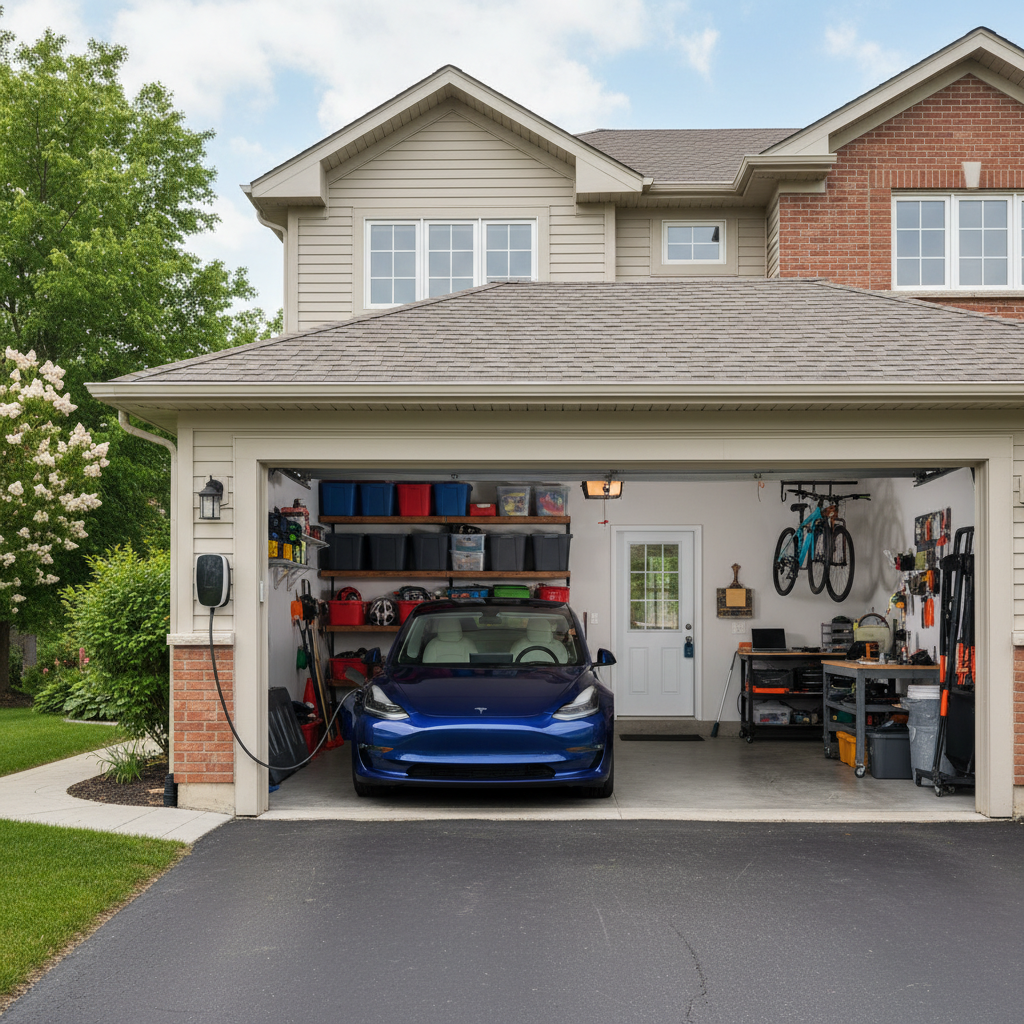
President Biden has made reducing vehicle pollution a part of his policy, but he has reduced subsidies and rolled back pollution regulations, leaving less federal incentive for would-be buyers. However, experts at research firm Telemetry believe that the biggest issue facing EVs may have less to do with policy and more to do with what’s in Americans’ garages.
One of the primary reasons for consumers’ hesitancy over EVs is thought to be charging. The majority of potential EV owners cite charging-related anxieties as a top concern according to surveys conducted in recent years. However, a new study from Telemetry Vice President Sam Abuelsamid of charging may have pointed to an as-yet under-discussed contributor to Americans’ unwillingness to go electric: the use of garages.
It’s all about the fast chargers these days, with Tesla’s Superchargers and General Motors’ Ultium Charge 360 seemingly on every corner. But most of that charging actually takes place at home. In fact, Telemetry estimates that about 80 percent of all EV charging takes place at a single family residence using AC power. What’s more, a recent study from the National Renewable Energy Laboratory (NREL) found that 42 percent of homeowners park next to a charging outlet capable of supporting level 2 (240 volt) charging.
This percentage would increase significantly, however, if homeowners were to make more room in their garages and stop using them as personal warehouses. Abuelsamid points out that “90 percent of all houses can add a 240 V outlet near where cars could be parked. Parking behavior, namely whether homeowners use a private garage for parking or storage, will likely become a key factor in EV adoption.”
Unlocking 240V Charging Access
Assuming people were to park in their garages and not in their living rooms, Telemetry estimates that the number of homes that could support EV charging would increase from 31 million to over 50 million. If one counts houses where wiring is possible, this number could swell to over 72 million. This is well in excess of Telemetry’s own most optimistic EV penetration forecast for 2035, which is between 33 million and 57 million vehicles.
There are, however, multiple barriers to this potential supply of EV-charging homes being ready for the rapid shift to electric vehicles. The NREL study also found that almost 34 million homes would need a potentially-expensive electrical upgrade to power a level 2 charger, which typically requires at least 30 amps. Such upgrades can be expensive, ranging from wiring to whole panel replacement.
It’s not the only cost EVs may present. Buyers have been sold on electric vehicles’ cost advantages over the long run. When a homeowner must purchase, rent, or otherwise pay for charging installation and infrastructure, the total cost of ownership can quickly approach or even exceed that of an equivalent gas-powered vehicle.
For many people, the problem is even greater because they don’t own houses at all. 23 percent of Americans currently live in multifamily dwellings, ranging from apartments to condominiums to co-ops to townhomes. While some of these properties have charging infrastructure, that infrastructure is difficult to provide at the individual level. An EV owner must go to a landlord, management company, or co-op board and ask for permission to install a charging station, which is no guarantee.
Moreover, installation of chargers is often much more expensive for multifamily housing than for single-family residences. In a co-op, for example, a management company may first have to install an entirely new electrical panel at the building, a multimillion-dollar proposition. Wiring may have to run to a distant garage. In many cases, multifamily residents are not eligible for municipal or utility charging subsidies.
Multifamily households account for around 23 percent of all US housing stock. About one million EV owners, or around one-third of all EVs, reside in these dwellings. However, these homes have poor EV charging support: just 11 percent of EVs in these homes can park within range of a 240V outlet. While some states are already mandating between 20 and 25 percent EV-ready parking spaces in new buildings, Telemetry expects that multifamily buildings will have just 6.7 million to 11.4 million charging-capable spaces by 2035. This is far short of anticipated demand.
Plug In Elsewhere
The inadequacy of home charging capacity will mean that the public charging network will become a very big deal in the EV era. Telemetry estimates that between 11.7 million and 14.3 million US EV drivers who own a house will use public charging in 2035. Another 7.8 million to 8.1 million EV drivers who live in multifamily homes will also rely on public charging.
Meeting this demand would require between 523,000 and 586,000 DC fast chargers and another 1.5 million to 1.6 million level 2 chargers across the US. As with home charging, there are significant barriers to this deployment of new charging infrastructure. The power industry, already straining to add power generation and transmission capacity to support new AI data centers, will have a very difficult time adding vast amounts of new charging infrastructure, especially large-scale fast chargers.
Wrapping Up
There is a lot of hype and optimism around electric vehicles these days, but the road ahead in the US is not as clear as many in the industry may think. While 72 million houses may be able to support a charging-capable home charger in theory, garage clutter, high upgrade costs, and the challenge of the non-homeowner will likely slow adoption of EVs, despite the rollout of a very large public charging infrastructure. Current infrastructure capacity is likely to be outstripped by demand over the next decade.
The future of electric vehicles in America could well depend on how people use their garages.