- calendar_today August 16, 2025
.
In a new study led by the Southwest Research Institute (SwRI), astronomers using NASA’s James Webb Space Telescope (JWST) have discovered a previously unknown moon orbiting Uranus. The icy giant is now known to have 29 moons, and astronomers expect more to be found.
Webb spotted the elusive body on Feb. 2 by analyzing a series of 40-minute-long exposure images from its Near-Infrared Camera. Only 6 miles (10 kilometers) across, the tiny moon is one of the smallest natural satellites of Uranus to be identified. It had been hidden in plain sight, its small size and the bright light reflected by Uranus’ rings having likely masked it from view to earlier missions and telescopes. It even escaped detection by NASA’s Voyager 2, the only spacecraft to have visited Uranus nearly 40 years ago.
“This is a small moon, but a big discovery,” said Maryame El Moutamid, lead scientist in SwRI’s Solar System Science and Exploration Division in Boulder, Colorado, and principal investigator of a Webb program to observe Uranus’ rings and inner moons. “We’re finding objects we’ve never seen before, and Webb can see much fainter than previous spacecraft. This just goes to show how Webb is pushing our knowledge far beyond the reach of earlier missions.”
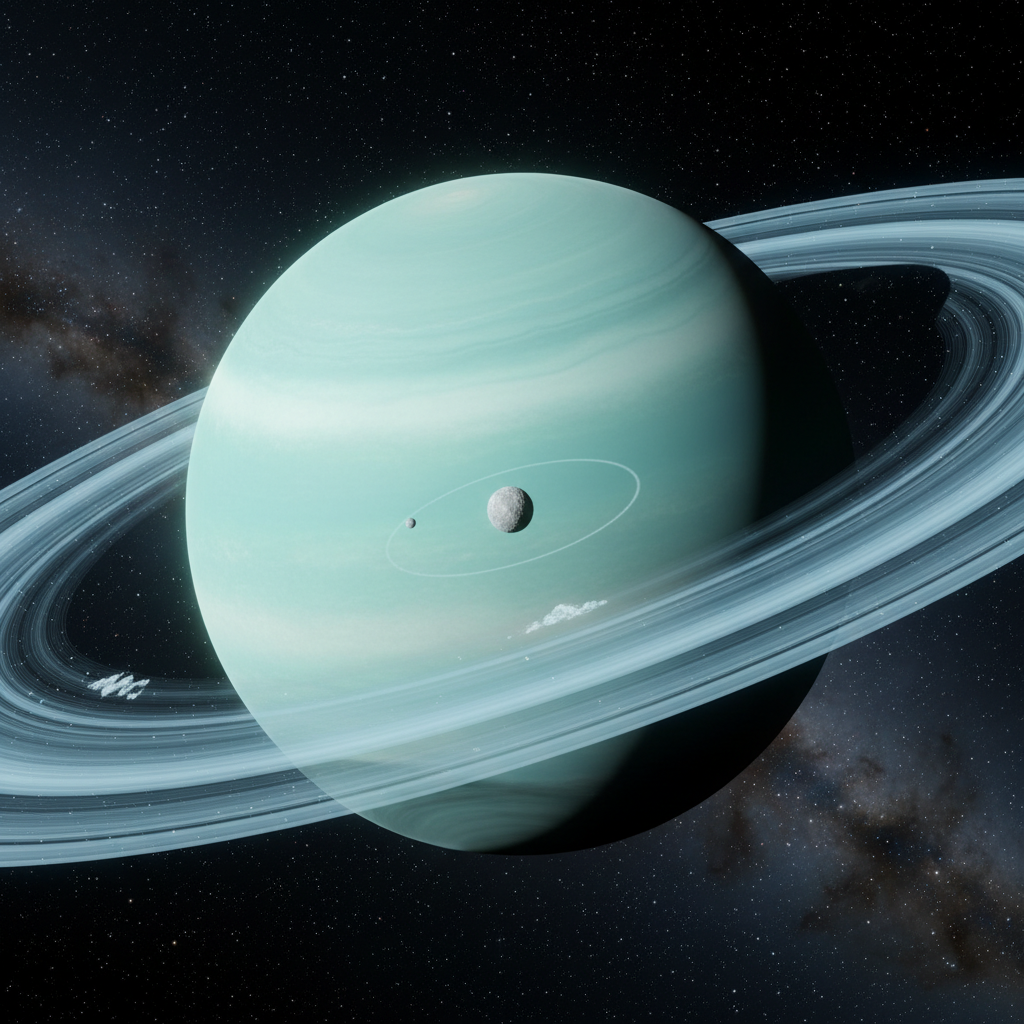
The new satellite, so far known as S/2025 U1, orbits about 35,000 miles (56,000 kilometers) from Uranus’ center. It follows an almost circular path around the planet within its equatorial plane, located between the known moons of Ophelia — just outside Uranus’ main ring system — and Bianca. Its orbit suggests that it could have formed close to where it is now.
The moon is dark, tiny, and moves quickly across the sky. This made it difficult for astronomers to distinguish it from the bright light reflected by Uranus and its rings. But Webb is sensitive to the dim glow of infrared light, and in this way, the telescope was able to spot it. Webb has already peered into Uranus’ rings, weather, and atmosphere; now this latest discovery will add to its record.
A Mysterious System Revealed
These moons orbit so close to each other that their orbits cross. But somehow, they seem to avoid collision and remain stable. One possibility is that they act as shepherds for Uranus’ narrow rings, containing and maintaining them.
“The discovery of this small moon of Uranus with Webb is very exciting,” said Scott Sheppard, an astronomer at the Carnegie Institution for Science who was not involved in the new study, but is a co-discoverer of one of Uranus’ moons, also found in 2024. “Its association with Uranus’ inner ring system makes this discovery particularly noteworthy, and we have Webb’s exquisite sensitivity to thank for this detection.”
This new moon is “even smaller and fainter than the tiniest of Uranus’ known inner moons, suggesting that others are hidden and waiting to be found,” said Matthew Tiscareno of the SETI Institute and co-principal investigator in the Webb Uranus project.
“The boundary between Uranus’ moons and its rings is fuzzy and indistinct,” he added. “Their complex inter-relationships hint at a chaotic history. The delicate interplay between Uranus’ satellites and its narrow rings reveals new aspects of our solar system’s history.”
“We’re finding objects we’ve never seen before, and Webb can see much fainter than previous spacecraft. This just goes to show how Webb is pushing our knowledge far beyond the reach of earlier missions.”
The new satellite, so far known as S/2025 U1, orbits about 35,000 miles (56,000 kilometers) from Uranus’ center. It follows an almost circular path around the planet within its equatorial plane, located between the known moons of Ophelia — just outside Uranus’ main ring system — and Bianca. Its orbit suggests that it could have formed close to where it is now.