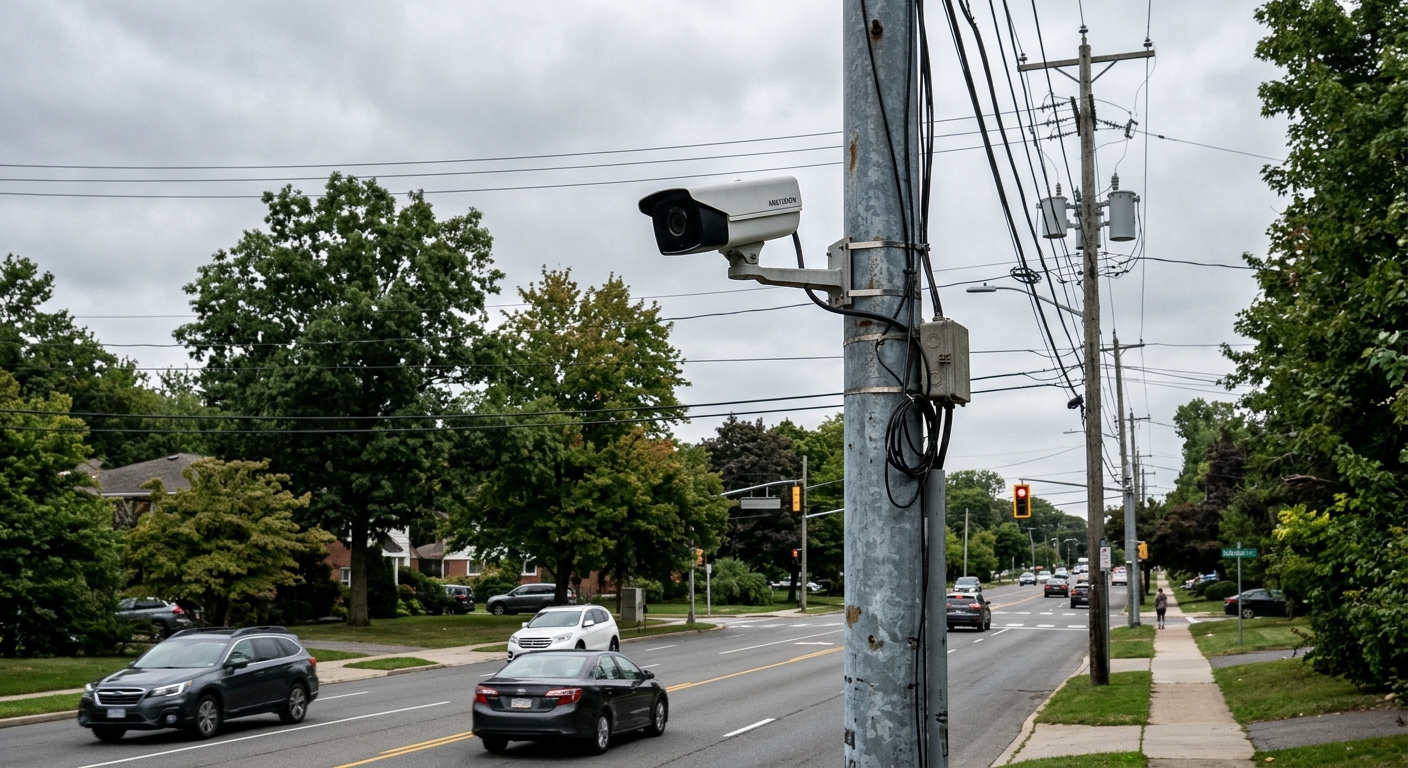
AI-generated illustration; not a photograph of the reported event.
- calendar_today October 26, 2026
Counties Move Forward as Suburbs Push Back on Flock Cameras
The expansion of Flock cameras—automated license plate readers (LPRs)—in the Twin Cities metro area has created growing tension between county sheriffs and leaders of suburban communities. As city councils increasingly resist or restrict the use of this surveillance technology, county sheriffs are launching new initiatives to install even more cameras, fueling debate over public safety, privacy, and government oversight.
License Plate Reader Deployments and Local Resistance
The Ramsey County Sheriff’s Office recently planned to install three Flock cameras in Vadnais Heights, but the Vadnais Heights City Council ordered a halt to the project pending further discussions on data management. Similarly, the Anoka County Sheriff’s Office is embarking on a one-year pilot program to add 73 more license plate readers across the county, set to begin next year. However, some cities—including Columbia Heights, Hilltop, and Nowthen—are seeking to opt out of participation or have asked that existing devices be removed.
Major cities in the region are also involved: The St. Paul City Council has called on Ramsey County to end its Flock contract, while the Minneapolis City Council pressed Hennepin County to remove its Flock cameras. Despite these objections, sheriffs continue to defend the use of license plate readers as essential crime prevention tools.
Surveillance Technology and Data Privacy Concerns
The core of the debate centers around how flock cameras amass and store data that can track the travel histories of vehicles. Proponents, like Ramsey County Sheriff Bob Fletcher, emphasize declines in crime and auto theft, crediting license plate readers with the ability to swiftly apprehend offenders. "A large part of that is because we have Flock cameras that can help us quickly catch the offenders," Fletcher said.
On the other hand, multiple city councils have voted to turn off or restrict these devices over fears of data misuse, police overreach, and potential federal immigration enforcement applications. National news about police misuse of surveillance data has only heightened bipartisan anxiety, sharpening calls for oversight and accountability.
Pilot Program Faces Scrutiny
In Anoka County, Sheriff Brad Wise launched discussions for a roughly $250,000, two-year pilot program to include additional cameras and remote drones. He pointed to recent cases—such as tracking a suspect in the attempted abduction and sexual assault of minors—as examples of the cameras’ value in public safety.
However, after a surge in federal immigration enforcement, county leaders like Commissioner Mandy Meisner began hearing increased resident concerns about data privacy and surveillance. A crowded four-hour town hall in Columbia Heights reflected the contentious public sentiment. In response, Wise trimmed the pilot program to a one-year, sub-$175,000 contract to avoid triggering required County Board approval, a decision Meisner said undermined public trust and due process.
Wise maintains he did not intend to sidestep public input but argues that coordinating with local police is necessary and the increasing politicization has complicated the process. He has since allowed cities opposed to the pilot to opt out, stating: “We’ll only put the tools in the places that want them.”
Pushback From Suburban Communities
Some suburban leaders have openly rejected the technology. The Nowthen City Council demanded that a Flock camera placed on a county road be removed after expressing concerns about lack of consultation from the sheriff’s office. Mayor Shane Hybben remarked that he found little public support for the cameras while campaigning. Hilltop Mayor Terry Wiggin also indicated his city will likely opt out over fears that misuse of surveillance data is too great a risk.
In Ramsey County, the Vadnais Heights City Council requested a meeting with the sheriff’s office to clarify data storage and sharing policies, pausing all installations in the interim. Meanwhile, both Anoka and Ramsey County sheriffs express concern that communities refusing the technology may see increases in crime.
Bipartisan Debate and Data Sharing Limits
The disagreement transcends political boundaries. While some conservative counties, such as Isanti County, have abandoned Flock cameras over privacy fears, some diverse, traditionally Democratic inner-ring suburbs have also removed or rejected the devices, especially because of concerns about federal immigration enforcement. A Star Tribune investigation found instances of local law enforcement searching camera data for civil immigration purposes, conflicting with state law requiring criminal investigation use only.
Columbia Heights Mayor Amáda Márquez Simula called the controversy a "bipartisan issue" with both sides worried about federal overreach. In response, Anoka and Ramsey County sheriffs pledged tighter internal controls, saying they only share data with agencies complying with state statutes and local policies. Flock Safety, the camera provider, maintains that departments own their data and can control its sharing and storage, now defaulting to deletion after seven days.
Discussions continue about seeking a middle ground—balancing public safety, privacy, and the evolving role of surveillance technology in local law enforcement.
Source: startribune.com.