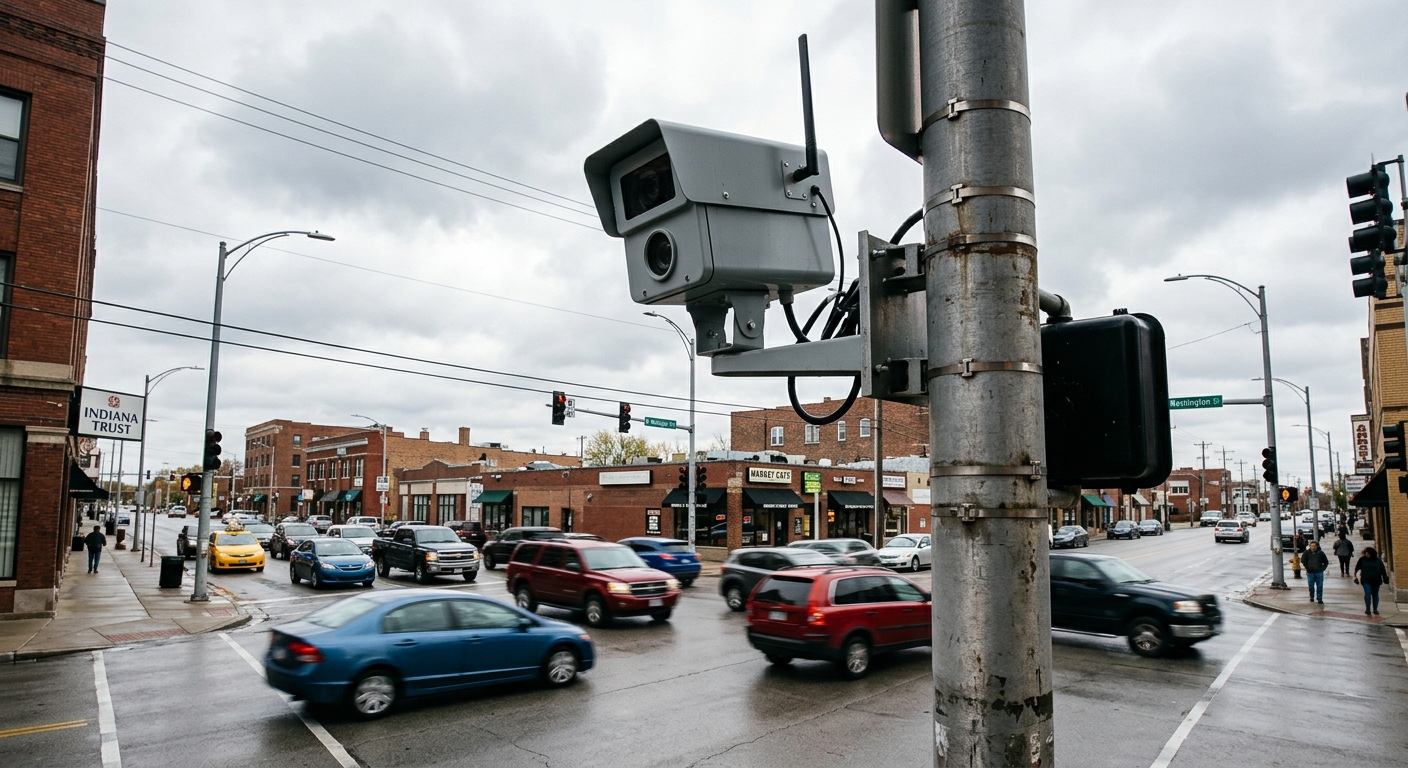
AI-generated illustration; not a photograph of the reported event.
- calendar_today October 11, 2026
Speed Cameras Impact Driver Behavior at Five Minneapolis Intersections
Minneapolis has seen a significant drop in speeding at five high-risk intersections after launching a speed camera pilot program. Over the first 12 months, city-operated cameras recorded more than 91,200 speeding violations, resulting in warnings or citations mailed to drivers. The pilot, part of the city's Vision Zero initiative to reduce traffic deaths and injuries, is showing marked progress according to recent city data obtained by the Minnesota Star Tribune.
Substantial Reduction in High-Risk Speeding
Prior to activating the intersection cameras, Minneapolis tracked speeding at the chosen locations to establish a baseline. Since the cameras went live, there have been 109,000 fewer instances of drivers exceeding the speed limit by 10 mph or more. The number of drivers traveling 20 mph or more over the posted speed fell by 68%—a reduction Ethan Fawley, the city’s Vision Zero program director, called a major win.
"That is 12,500 fewer drivers at 20 miles over," Fawley said. The primary objective has been to make roads safer and reduce dangerous speeds, and officials report they are "pleased with the results and safety benefits we see." According to data, 98% of drivers at the camera locations now comply with the speed limit or are only going up to 9 mph over the limit.
Pilot Program Details and Speeding Fine Structure
The speed camera pilot received legislative approval to run for four years through 2029. The technology captures rear license plate photographs of vehicles going at least 10 mph above the speed limit. Offenders receive a warning for a first offense, with subsequent citations fined at $40. Drivers detected speeding by 20 mph or more face escalating fines of $80. Notably, violations do not impact driving records unless the driver holds a commercial driver's license.
Intersection Locations and Speeding Hotspots
Among the five intersections monitored, the 4700 block of southbound Nicollet Avenue S. (speed limit 25 mph) had the most frequent instances of excessive speeding. Cameras there detected over 15,200 vehicles traveling at 35 mph or faster, resulting in 11,573 warnings and 3,623 tickets. The next highest violation spot was N. 3rd Street at 1st Avenue N., which serves as an on-ramp area for westbound I-94; these cameras generated 11,933 warnings and 2,670 citations. Additional cameras were placed on 18th Avenue NE. near Central Avenue, Fremont Avenue near West Broadway, Chicago Avenue S. near Franklin Avenue, and the 4600 block of northbound Nicollet.
Financial Status and Program Sustainability Concerns
Despite the large number of speeding violations and fines issued, the speed camera pilot program is not currently profitable. The city reported expenses of approximately $451,790 against revenues of $231,381 as of August. City spokesman Allen Henry attributes this deficit to delayed payments and expects finances to improve as roughly $653,000 in unpaid citations are collected. The city is collaborating with local courts to streamline payment processing. Henry noted, "we expect the program will be financially self-sustaining" once payment systems are operating smoothly.
Importantly, the program is not designed to generate income. Any excess revenue, under state law, must be reinvested in traffic safety improvements.
Future of Speed Camera Traffic Enforcement in Minneapolis
The pilot is scheduled to continue through 2029 and may expand if the city budget permits. Although officials hoped to install additional cameras in 2026 and possibly introduce technology to catch red-light violations, fiscal prudence led to a pause in expansion this year. "We hope to add some in 2027," Fawley said, emphasizing that the pace of growth is dependent on city budget decisions currently in progress.
City data also highlights the importance of such initiatives: speeding was a factor in 80% of fatal crashes in Minneapolis in 2024. With high rates of speed contributing to roadway danger, city leaders are monitoring the speed camera pilot as a tool for ongoing traffic crash reduction and greater speed limit compliance moving forward.
Source: startribune.com.